


Where Do Great Strategies Really Come From?
Abstract
In courses on business strategy, students draw maps of organizations and the landscapes on which they operate, and they learn various classification schemes for strategies, such as different kinds of market positions or organizational capabilities. But these activities do not achieve much when it comes to developing a sense for where great strategies come from in the first place. The missing ingredient is recognizing that strategy-making is a creative act. We know this intuitively. It is the “aha” feature of brilliant strategies that first draws many of us to the topic. In this essay, we look at some examples of great business strategies and view them as creative leaps. We organize the examples into a proposed framework which involves four sources for creativity: contrast, combination, constraint, and context (4 C’s). The hope is that this framework works as a mental prompt for finding new strategies.
1. Introduction
Taking a course on business strategy can be a somewhat bittersweet experience. On the one hand, there is the exciting promise of discussing examples of brilliant ideas and moves, of strategic “aha!” moments, of how good thinking has led to business success or bad thinking to failure. On the other hand, the reality of strategy courses can be rather mechanical, involving the filling in of frameworks and boxes, the itemizing of various factors said to bring about success or failure, and other somewhat formulaic activities. Case studies of interesting organizations enliven and enrich the learning experience. But is something missing? Is it, in fact, an unfortunate reality that courses on business strategy largely fail to address what is probably the most exciting question: “Where do great strategies really come from?”
In this essay, we will suggest that this is the current reality. But we will also make a proposal for bringing a course on business strategy closer to addressing this exciting question.
2. Maps and Taxonomies
Strategy students draw maps—the Strategy Wheel, the Five Forces, and other well-known depictions of the organization in itself and as situated in its environment (Learned et al. 1965; Porter 1980, pp. xv–xvi). Strategists in other areas of human activity draw maps, too. Military strategists employ maps of the physical terrain, and they want to know about the deployment of opposing (and allying) forces. Analogous statements can be made about political strategists. Maps become almost completely literal if we are talking about strategy in chess, where board positions are drawn and analyzed.
Map making is clearly a meaningful and necessary activity when making strategy. One needs a disciplined way to look up and around and to situate oneself. One can even say, in reference to the classic OODA (Observe-Orient-Decide-Act) loop for decision making in the military (Boyd 1976), that observing and orienting oneself are the first two steps, coming prior to deciding on a strategy. But that is precisely the point. Making a map (or reading a map) is not, in itself, strategy.
Along with map making, another staple of courses on business strategy is discussion of necessary conditions for a strategy to be successful and some kind of classification or taxonomy of various successful strategies.
Different approaches to business strategy have different ways of talking about what is necessary for success, but they all, fundamentally, point to the need for some kind of distinctiveness. The taxonomies one finds of various successful strategies are about listing different kinds of distinctiveness. Under the heading of positioning, one finds the well-known generic strategies, or, more comprehensively, different routes to added value (Brandenburger and Stuart 1996; Ghemawat 2009, chap. 3; Porter 1980). Likewise, categories of different kinds of organizational capability, or dynamic capability, have been suggested (Eisenhardt and Martin 2000, Teece et al. 1997).1,2
Similar to map making, classification of strategies is a valuable exercise. As a general matter, having a good sense of what is possible—especially, a good sense of the breadth of possibility—is a useful stimulus to one’s thinking. Also, while too direct a comparison with the sciences would be pretentious, it is true that classification is fundamental in many scientific fields (Linnaeus and his classification of animals, Mendeleev and his classification of elements, etc.). Classification as an important activity does not need much defense.
With both map making and classification, we may now have got closer to the matter of how successful strategies actually arise. But if we stop here, we will still have fallen short. Unfortunately, this is where many strategy textbooks and courses do stop, more or less.
3. Minds Matter
The missing ingredient in what we have talked about so far is this: strategy making is a creative act. That is the hypothesis of this essay. People sense this at an intuitive level. When we first start hearing about and reading stories and cases about business successes (or failures), it is the clever novelty of various people’s thinking and actions in the business world that makes for the most exciting and enticing examples. It is this “aha” feature of the successful move or series of moves that draws many (all?) of us to the area of business strategy. We suggest that to address the question of this essay—where do great strategies really come from?—it is important not to lose sight of this initial attraction to the field.
Here is another hint that strategy making as a creative act should be at the center of our picture. Schumpeter introduced the idea of creative destruction into the worldview of economics and entrepreneurship—an idea that has been central to business scholarship ever since. In a very different setting, Picasso said, “Every act of creation is first an act of destruction.” This coincidence of words across these two very different worlds of the economy and of the arts can hardly be a coincidence. Let us recognize the common feature, which is the human mind involved in replacing the old with the new, across various areas of human endeavor.
It is not original to say that we should keep track—in the midst of all the strategy frameworks we learn and teach—of the basic fact that it is the human mind at work that determines strategy. A flourishing area of recent writing on this point goes under the heading “managerial cognition” (Gavetti 2012). The main proposition here is that successful strategy and performance come from looking beyond what is cognitively close to the status quo (therefore, easier to think about) to what is further out (therefore, harder to think about). Superior cognition leads to superior strategy making. Interestingly, Schumpeter is quoted on this point: “Passively ‘drawing consequences’ is not the only possible economic behaviour. You can also try and change the given circumstances. If you do that, you do something not yet contained in our representation of Reality” (quoted in Gavetti 2012, p. 267; originally from Schumpeter 1911, p. 104; translated by Becker and Knudsen 2002). Changing the circumstances, or changing the game, or some other similar phrase—these are the cognitively more challenging, but also more rewarding, moves.
But to say that strategy making is a creative act is to take an additional step. This is because creativity is usually thought of as a “whole-brain” activity. The headline version of this point is to say that creativity is a right-brain activity, as distinct from logic and analysis, which are left-brain activities. But the more accurate statement is that both sides of the brain (which do exhibit some specialization) and their interaction are important in higher-order activities. Creativity is one such activity and, therefore, involves the whole brain (Kaufman et al. 2010). We must similarly allow that strategy making is not just a kind of applied logic but involves a variety of mental processes.
At this point, we face a choice. We could delve further into what is known about creativity from a neuroscience perspective and see whether there are lessons to transfer to the world of strategy making. This is likely overambitious at this point in the development of neuroscience.3 So we will adopt a less ambitious approach and simply take a look at some well-known strategies—a look with a heightened sensitivity to the possibility that great strategies come from creative leaps, as we informally understand this term.
4. Creative Cases
We will try to determine whether we can gain some further insight into strategy making by taking a creativity perspective. Let us take a look at some examples of what clearly seem to be great business strategies, and we will see what happens when we try to view these strategies as creative leaps.
One of the most often cited examples of “out-of-the-box” business strategy is the decision by Henry Ford in 1914 to double the wages of his workers. He made this decision to boost morale and, in this way, to reduce turnover. Ford also noted a larger picture, which was that if businesses in general paid their workers more (at least to a point), their increase in purchasing power would benefit all businesses.4 What is notable about this decision is the sharp contrast it represents with the conventional wisdom, which was (and often still is) that when it comes to wages, it is a zero-sum, not a positive-sum, game between a business (in particular, its shareholders) and its employees. There is also a literalness in Ford’s move. If the conventional wisdom says to try to make a quantity (wages) smaller, ask if it might actually make sense to make this quantity bigger.
Viewed this way, what Ford did was a classic creative move. Creators in many fields operate by asking if the conventional wisdom can, in some very literal way, be turned on its head. For example, Walt Disney (as creator) posed this question when he asked whether it is possible, in contrast to conventional films, to have “music you can see and pictures you can hear.” His 1940 masterpiece Fantasia showed that the answer was yes.5 One can think of many other examples of what we can call creativity from contrast.
We think that this perspective brings us closer to answering the question of where a great strategy comes from. Of course, we cannot know exactly what Ford’s mental processes were. (People may not even know their own mental processes.) But it does seem reasonable to say that they included a strongly creative component. Moreover, we suggest that it is generative to argue this way. We are prompted to look at other business situations and ask if a very literal contrasting move could be effective. For example, if an industry conventionally bundles certain products together, should it try unbundling?6 If the traditional retail model is to start big (with a large store) and then add small (via satellite locations), should we instead start small (and then, perhaps, go big)?7
Let us try another example: the birth of desktop publishing in the mid-1980s. This came about when Apple, Aldus, and Adobe brought together their technologies—the Macintosh desktop computer, PageMaker publishing software, and PostScript page description language, respectively—in a way that allowed users to create professional-level documents at their desks. Here, the key feature is the combinatory nature of the move. The desktop publishing revolution took place only because three different pieces of the needed picture were correctly identified and assembled by the people involved. In addition, assembling these components was not an obvious move since desktop publishing was not an obvious application at the time (Isaacson 2011, p. 131).
Combination is another canonical creative move. Indeed, a number of people go as far as to define creativity in these terms. Steve Jobs famously said that creativity is “just connecting things” (Wolf 1996), and Albert Einstein wrote about the “combinatory play” of ideas (Popova 2012, 2013). The power of combination is often said to be greatest when the ingredients brought together seem distantly related or even to be in some tension with one another. There is a surprise factor in productive combination.8
We suggest that here, too, there is a generative aspect to digging down to the creative layer of strategy making. This time, we are prompted to look at business situations and ask if there are productive combining moves to be made—even moves that bring together quite different-looking businesses. For example, nonfinancial and financial products have often been combined to build markets. In the early days of the automobile, General Motors (GM) did this when it formed a financing arm to provide loans to car buyers. In today’s world of social media, the Chinese platform WeChat offers a highly integrated mobile payment system (WeChat Pay) that enables users to buy and sell products within their social networks.9
A different kind of business strategy, which is surely very creative, is the one that begins with a constraint or limitation and then finds a way to turn such a potential weakness into a strength. A classic example is the way that Pepsi, in its early days in the 1930s and for a long time afterward, repeatedly turned its then-challenger position vis-à-vis Coke into an advantage. Pepsi’s clever moves included charging a low price (expensive for Coke to match over its larger volumes), developing then-new supermarket channels (an initial conflict for Coke given its traditional channels), and inventing lifestyle advertising targeted toward young people (also an initial conflict for Coke given its “heartland” image).10 A current example might be Tesla’s lack of a traditional dealership network. Although not precisely an intentional move on Tesla’s part, this apparent disadvantage does give Tesla control over its pricing. By contrast, buyers of GM’s Chevy Bolt have encountered large price differences across GM dealers.11
Now, the story of Pepsi versus Coke is a staple of business-strategy courses. This is an important point. As noted at the beginning, cases enrich and enliven the learning experience. We also see that cases very naturally touch on the underlying creativity of their protagonists’ actions. Clearly, the creativity of business strategies is not completely absent as a topic from strategy courses. That would be a false, even absurd, claim. Rather, what we claim is that the commonly used overarching frameworks do not emphasize this aspect of strategy.
Returning to the role of constraints and limitations, this is, just like the role of combination, much discussed in the creativity world. The arts are full of examples of famous creators who turned obstacles or setbacks not into limits on their lives but into moments that led to great accomplishment. Creators may deliberately choose to impose constraints on themselves—as when someone consciously adopts the rules of a particular form of poetry or music. In military affairs, there are many examples of strategic breakthroughs that arose from turning constraints into opportunities. Guerilla warfare provides a prime case. In the Middle East theater in World War I, the British strategist T. E. Lawrence (known as “Lawrence of Arabia”) led the Arab armies in fast-moving guerilla-style attacks against the better equipped but largely stationary Turkish occupiers. Lawrence explained that the essence of his approach was to “convert Arab weaknesses into strength and Turkish strength into a weakness” (quoted in Liddell Hart 1989, p. 380).
It is not surprising to find that constraints can stimulate clever thought and action in the business world, too. The traditional SWOT (strengths, weaknesses, opportunities, and threats) analysis asks us to identify the weaknesses in our situation and to work to ameliorate them (Andrews 1971; see also Learned et al. 1965). Thinking in terms of strategy from constraint is different. We are prompted to ask if what appears to be a weakness can, in fact, when viewed or used differently, become a strength. There is a further generative step, when we ask if we might even benefit from voluntarily imposing constraints or limits on our own organizations. To some degree, self-restraint is inherent in any clear choice that an organization makes, since choice means not doing something else (Martin 2014). But there are also more self-conscious and dramatic cases, such as the famous set of design tenets to which the office furniture firm Herman Miller adheres.12
Our final example is the creation of Intel’s “Intel Inside” marketing strategy, which dates back to 1991. This highly successful move, which increased Intel’s power with respect to the computer makers (such as IBM), followed an established idea in other consumer product sectors, where branded ingredients such as Teflon and NutraSweet had seen great success. By switching its thinking from the hi-tech context to other consumer products, Intel found a new and effective strategy (Tedlow 2006, chapter 13; Harnish et al. 2013, chapter 613).
The importance of context and, therefore, switching contexts, in influencing one’s thoughts and actions is another staple in writing on creativity. Call it changing frames, perspectives, or vantage points—this spur to creativity is often viewed as particularly important when creators are blocked or stuck in their thinking.14 It is a well-known problem-solving technique: find the solution to a problem in one domain by finding another domain in which an analogous problem has already been solved.15
Lead-user and extreme-user techniques in business can be understood this way. They are about shifting one’s stance from looking only at the mainstream users of a product or process to looking for users who have particularly demanding needs.16 To address their advanced needs, users in this second set may have come up with their own alterations or innovations to the basic product or process. These user-led innovations can then be brought to the mainstream to advance the whole market. Context switching can be a powerful way to move one’s thinking and actions forward.
5. Two Answers
This is our first answer to the question, where do great strategies really come from? They come from our creative selves. It is creativity exercised in a particular setting: the setting of business. We need to learn the “grammar” of this setting. This is what learning maps and taxonomies gives. But to go beyond grammatical exercises—that is, to have and to speak original thoughts—we need to engage our creativity.
Our second and next-level answer is that creativity can, in turn, be usefully decomposed into several kinds. The examples in the previous section identified four kinds: creativity from contrast, from combination, from constraint, and from context. See Figure 1. Of course, this picture of creativity—and, therefore, strategy—from four directions is a framework and not more. There is no claim that these four directions are all-encompassing. Equally obvious, there is no claim that use of this framework can guarantee the “greatness” of new ideas and strategies that emerge. At best, any such framework can act as a prompt to the generation of new ideas and strategies that are candidates for greatness.
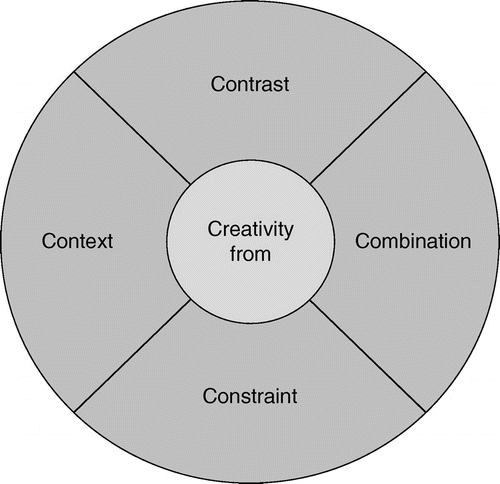
It might seem that, in putting forward this framework, we are returning to the classifying activities that we said earlier are not sufficient to address the question of where great strategies come from. We are returning to classifying activities, but with a difference. This is because the scheme in Figure 1 is not a classification of strategies but a classification of the origins of (successful) strategies, and it is these origins that we are after. Still, different classification schemes can be more or less useful. Is the framework in Figure 1 useful? We began to put it to work in the previous section. We not only used it to label the examples of strategy making that we covered. We also suggested that the categories—contrast, combination, constraint, and context—could be good mental prompts when we engage in our own strategy making. But, in the end, any framework is simply a heuristic, and its value cannot be determined in advance. Only after a framework has been used for a while can we judge how illuminating and generative it is or is not.
The world of business moves fast. In recent years, design thinking has become one of the most widely used techniques to enhance creativity in the product development process. Building on this success, leading design-thinking firms such as IDEO and Frog have begun strategy-consulting practices to inject more creativity into the general strategy-making processes of their clients. At the same time, leading strategy-consulting firms such as McKinsey & Company have added design-thinking tools to their repertoire. There has been a blurring of boundaries between the creativity (at least, in the form of design thinking) and consulting sectors.17
To some degree, then, the real world has run ahead of the hypothesis advanced in this essay. This is not, of course, proof that the hypothesis is correct. Management thinking is well known to be subject to fads and fashions. At the same time, to ignore this trend would be too purist a position. It is reasonable to suppose that, much of the time, the ideas and approaches in play in the strategy field have a degree of validity. After all, business strategy is not an exact subject, capable of being reduced to one correct viewpoint. There are multiple viewpoints and many of them very likely offer some degree of insight. If strategy as creativity has some currency in the world of practice today, this is some support for making the creativity of strategy making a theme in thinking about and teaching business strategy.
So, a course on business strategy ends. It has done a good job addressing the question of where great strategies really come from. It has not provided a definitive answer, because a definitive answer would be suspect. But, perhaps, a good answer is that great strategies come, in good part, from great creativity.
This work has benefitted greatly from insights due to the author’s co-instructor Jeff Lehman and to students in the course Creativity Considered (at NYU Shanghai). The author is also very grateful to Mengzhu Chen, Yuqing Li, Yixu Lin, Natalya Vinokurova, Shellwyn Weston, and participants at a workshop at Apple University (Cupertino, California) for valuable comments; to Giovanni Gavetti and Joe Porac for excellent editorial input; and to Rena Henderson for copyediting expertise.
1 Positioning and capabilities are related. The latter are about the ability of an organization to improve its position—that is, to move faster than the competition. Thus, capabilities can be thought of as about speed (even, perhaps, depending on what one reads on the topic, as about acceleration) versus position.
2 For an update of this work to the world of digital strategy, see Schuen and Sieber (2009).
3 For a review of the current state of affairs, see Abraham (2013).
4 See Watts (2006), chapter 10.
5 I am grateful to Katie Lee for pointing me to this example.
6 In the music business, unbundling (via streaming) was a response to the conventional bundled (CD) model. In higher education, the degree program is a bundled product. Challengers such as General Assembly have entered with unbundled offerings.
7 This is the concept of the pop-up store. I am grateful to Eliot Gattegno for this example.
8 In the creativity literature, the term “bisociation” means to “join unrelated, often conflicting, information in a new way” (Koestler 1976, p. 113).
9 Cars and loans, or social networks and payment systems, are complements. For more on complements and business strategy, see Brandenburger and Nalebuff (1996), chap. 2.
10 See www.pepsi.com/ads_and_history/legacy (accessed August 17, 2017).
11 “How Tesla’s Turning Weakness Into Strength,” Barron’s video, 0:48, posted March 24, 2017, http://www.barrons.com/video/how-tesla-turning-weakness-into-strength/D8CC59A8-B7CE-4649-B332-CE1D072B4EC2.html.
12 For the list of tenets, see https://www.hermanmiller.com/content/dam/hermanmiller/documents/brand_guidelines/Herman_Miller_Global_Brand_Standards.pdf.
13 This book also covers Henry Ford’s decision to double his workers’ wages (in chapter 18).
14 A classic reference on this point is Cameron (2016).
15 On the use of analogy in business strategy, see Gavetti and Rivkin (2005). Looking for analogies is one of the problem-solving techniques in the classic reference Pólya (1945).
16 For source material on lead-user and extreme-user techniques, see, respectively, von Hippel (1994) and https://dschool-old.stanford.edu/wp-content/themes/dschool/method-cards/extreme-users.pdf (accessed August 17, 2017).
17 For a partisan point of view on this convergence (favoring the design thinking side), see Morey (2016).
References
- (2013) The promises and perils of the neuroscience of creativity. Frontiers Human Neurosci. (June 5), https://doi.org/10.3389/fnhum.2013.00246.Google Scholar
- (1971) The Concept of Corporate Strategy (Richard D. Irwin, Homewood, IL).Google Scholar
- (2002) Schumpeter 1911: Farsighted visions on economic development. Amer. J. Econom. Sociol. 61(2):387–403.Crossref, Google Scholar
- (1976) Destruction and creation. White paper, United States Army Command and General Staff College, Fort Leavenworth, KS.Google Scholar
- (1996) Co-opetition (Doubleday, New York).Google Scholar
- (1996) Value-based business strategy. J. Econom. Management Strategy 5(1):5–24.Crossref, Google Scholar
- (2016) The Artist’s Way, 25th anniversary ed. (TarcherPerigee, New York).Google Scholar
- (2000) Dynamic capabilities: What are they? Strategic Management J. 21(10/11):1105–1121.Crossref, Google Scholar
- (2012) Toward a behavioral theory of strategy. Organ. Sci. 23(1):267–285.Link, Google Scholar
- (2005) How strategists really think: Tapping the power of analogy. Harvard Business Rev. (April), https://hbr.org/2005/04/how-strategists-really-think-tapping-the-power-of-analogy.Google Scholar
- (2009) Strategy and the Business Landscape, 3rd ed. (Prentice Hall, Upper Saddle River, NJ).Google Scholar
- ,
editors of Fortune (2013) The Greatest Business Decisions of All Time: How Apple, Ford, IBM, Zappos, and Others Made Radical Choices That Changed the Course of Business (Fortune Books, New York).Google Scholar - (2011) Steve Jobs (Simon & Schuster, New York).Google Scholar
- (2010) The neurobiological foundation of creative cognition. Kaufman J, Sternberg R, eds. The Cambridge Handbook of Creativity (Cambridge University Press, Cambridge, UK), 219–222.Crossref, Google Scholar
- (1976) The Act of Creation (Hutchinson, London). [Orig. pub. 1964.]Google Scholar
- (1965) Business Policy: Text and Cases (Richard D. Irwin, Homewood, IL).Google Scholar
- (1989) Lawrence of Arabia (Da Capo, New York). [Orig. pub. 1935. Colonel Lawrence: The Man Behind the Legend].Google Scholar
- (2014) The big lie of strategic planning. Harvard Bus. Rev. (January–February), https://hbr.org/2014/01/the-big-lie-of-strategic-planning.Google Scholar
- (2016) Strategy as a creative act II: The limits to management consulting. Design Mind (December 21), https://designmind.frogdesign.com/2016/12/strategy-as-a-creative-act-ii-the-limits-to-management-consulting/.Google Scholar
- (1945) How to Solve It: A New Aspect of Mathematical Method (Princeton University Press, Princeton, NJ).Crossref, Google Scholar
- (2012) Combinatorial creativity and myth of originality. Smithsonian (June 6), https://www.smithsonianmag.com/innovation/combinatorial-creativity-and-the-myth-of-originality-114843098/.Google Scholar
- (2013) What is creativity? Cultural icons on what ideation is and how it works. Brain Pickings (September 6), https://www.brainpickings.org/2013/09/06/what-is-creativity/.Google Scholar
- (1980) Competitive Strategy: Techniques for Analyzing Industries and Competitors (Free Press, New York).Google Scholar
- (2009) Orchestrating the new dynamic capabilities. IESE Insight Fourth Quarter(3):58–65.Crossref, Google Scholar
- (1911) Theorie der wirtschaftlichen Entwicklung (Duncker & Humblot, Berlin).Google Scholar
- (2006) Andy Grove: The Life and Times of an American (Portfolio, New York).Google Scholar
- (1997) Dynamic capabilities and strategic management. Strategic Management J. 18(7):509–533.Crossref, Google Scholar
- (1994) The Sources of Innovation, Reprint ed. (Oxford University Press, Oxford, UK).Google Scholar
- (2006) The People’s Tycoon: Henry Ford and the American Century (Vintage, New York).Google Scholar
- (1996) Steve Jobs: The next insanely great thing. Wired (February 1), https://www.wired.com/1996/02/jobs-2/.Google Scholar
Adam Brandenburger holds appointments at New York University as J. P. Valles Professor at the Stern School of Business, distinguished professor at the Tandon School of Engineering, faculty director of the NYU Shanghai Program on Creativity + Innovation, and global network professor. He received his B.A., M.Phil., and Ph.D. degrees from the University of Cambridge. He researches in the areas of game theory, information theory, and cognitive science.

